Seems that a page of kite terms has been suggested.
Lets DO IT !
AoA - Angle of Attack . The way the kite is tipped into the wind. ARC - A unique 4 line Twin skin , closed cell depower kite made only by Peter Lynn.
ATB - all terrain board
Bridle - the lines that combine to form your Canopy . Bow - LEI kite with bridles. Bowtie- kite gets twisted. Brakes - the back lines on a 3 or 4 line
kite. Used for turning , slowing , backing down and relaunching the kite.
Closed Cell - Tapered sock like inlets on a kite that resist air flowing back out. Useful for water relaunch. CBE-CoolBreeze Ejection or KEEGLE . Getting launched from your buggy and landing on your feet. ( PKF inside
joke ) C kite ( original ) LEI kite with strong C shape. 4 or 5 lines. Coyotes - off road rollerblades. Chicken Loop. The loop on your trim strap
used for hooking in to your harness.
Depower - a kite that uses 4 or more lines to adjust the AoA of the kite By the bar and a depower strap. To Depower a kite is tset it at an angle that
the wind passes with least lift / interferance. Delta - an LEI shape Doomwheels - home made off road roller blades. Donkeydick - The little finger
that holds your Chicken loop in.
Eeeee - The sound I make after a good jump!
Fixed Bridle - Kites bridle points do not move. Very little AoA adjustment. Fifth line - A line to the centre of a kite that comes into play on safety
release. Four line- a kite that uses lines on the 4 corners to increase control.
Hooked in - Connecting your kite to your harness . Harness is method of attaching to the kite and spreading the power to your core. Seat and waist
harnesses are most common.
I - ???
Jibe - "to change direction by swinging a for and aft sail across a following wind"
Kite Killers - Straps from your wrist to brake lines on FB kites . Knotts. Kts. Nautical speed .
LEI - leading Edge Inflated kite.Loop - To turn the kite and hold the turn 360 degrees. Downloop starts at the top and is a 180 degree turn in the
opposite direction. Larks Head - a loop knot used for attaching lines. Luft- the kite losses air and falls back . Usually do to a lull in the wind or
over flying.
Mountian board - or All Terrain Board. Beefed up skateboard with pneumatic wheels for kiting on land
Newbie - a beginer NPW - A single skin bridled kite
OBE - Out of Buggy Experience. Getting launched from your buggy and not landing on your feet. ( see CBE ) Open Cell - a foil kite that has no
restriction to the air flowing in or out. Overfly - To allow the kite to travel upwind and out of the wind window..OS - Oh #@%$#!e loops knobs or
handles on your brake lines to back the kite down + reverse launch.
Projected area - The amount of effective kite area once shape has been formed. Arcs have a much smaller projected area than their measured size. Foils
and Lei ,less so.
Q line - A type of flying line of high quality. Does not require sheathing. QR - Qiuck release . Your kites safety release.
R.I P. AJ RedBull - it gives you wings! Rag Flapper - NPW pilot
Safety - A system incorperated into the kite control system to reduce power in a bad situation. Safety gear : Helmet and gloves are minimum ( in my
opinion ) Elbow , knee and butt pads are all valuable .The importance of safety can not be stressed enough in this sport ! YOU are and Ambassador
every time you go out ! Strop - a strong line joing the tops of kite handles for hooking in to harness. Scudd - to skid downwind using the power of
the kite. A good safety move to learn. Spreader - a bar on the fron of a harness to spread the load and attach to the kite. Hook and Roller spreaders
are most common.
Tips. Tip tuck . The ends of the kite. Tip tuck can happen when turning and you lose air in the kite. It gets stuck in the bridle and requires some
shaking to break loose. Two line kite - kite that can only be flown left and right. Very difficult kite to relaunch and so not the best choice for
learning. Three line kite- a kite that combines the brake lines into a 3rd line for safety and relaunch. A much better choice for learning . ( see 4
line ) Trim - to adjust the AoA of your kite either by trim strap or bar.
Upturn - turning the kite up toward zenith . The most common turn.
Vapor - the Fastest buggy race kite at the moment.
Wind window . The kite can only fly in the 1/4 sphere downwind of you. To the top , right and left are the edges of the window and the least power is
felt in the kite there. The more you fly the kite downwind and low the more power is produced as it passes through the window.
XXtreme - The best buggy out there .
YeeHaw ! What we Albertans say when we are kiting !
Zenith - the point directly above your head that the kite will want to sit at .
Crispy Ribbons- my term for new gear. most new kites come packaged with strips of ripstop nylon tied around them and new control bars. they look like
ribbons to me!
OSF- OH #@%$#! face- face i make when things are getting sketchy
White Knuckle Jump- going so big that you are scared you are gonna die, so you squeeze the control bar so hard your knuckles go white
Kite Rage- extreme road rage I get when i drive to the field and the traffic is really bad causing me to lose kite time.
Un-kitefit- sore body after the first session of the season when you are out of shape
Backline tension- the way you are supposed to launch arcs so they can inflate properly without the dreaded bowtie
calling my girlfriends- calling my buddies to tell them about an awesome kite session
I - Invoking the wind. Praying for sufficient wind for the the kite you want to fly on a given day... or for any wind at all. Sometimes
done discreetly so as not to involve mental health professionals.
Hot launch- Launching your kite from the direct down wind direction whether you are standing or sitting in your buggy when the winds are cooking! (not
recommended for beginners)
Scudd- the awesome slide you get when you hot launch or bring your kite directly into the "power zone" while static flying, (causes you to yell Yee
Haw see definition above). Doing kite loops in the " power zone" will also improve your chances of a decent scudd!
Nuking winds- Those winds which most of us decide it is time to pack up and play it safe. Requires huge keewee's(sorry Kami :tumble and a tremendous amount of experience before this can be done without taking a ride
in a fancy vehicle with flashing lights and sirens!
Watch this- the term that is used before someone does something pretty ridiculous and usually hurts themselves pretty good and gets to take one of
those flashy light, loud, fancy vehicle things ride just like above. Also causes the rest of the day to be shot! Please use extreme caution after
using this term.
Lull- mother natures cruel way of trying to ruin a completely great run. This is when after launching your kite in great winds, mother nature decides
to test your ability and takes the wind away from you just for an instant. This causes your kite to fall in the power window with no power. Once your
kite gets right back in the " power zone" mother nature says "watch this" and turns the wind back on causing your kite to fill quickly in the window
and tries to rip your arms from you body!
This is fun!( mind you I have been up for 22 hours some of these may really ramble on)
Rich
NAPKA President
US 66 www.napka.org
rich@eastcoastkitesports.com
rich@vantantech.com
rich@wildwoodbuggybash.com
Want a custom VTT buggy, or VTT XR Side rail and seat upgrade Kit, call me!
302-480-6008
HQ, Peter Lynn, Prism, Trampa,
Home built big wheel buggy. Low and wide!!
Check out the Wildwood Buggy Bash Facebook page!
I'm going to ping the admins of PKF to see if there is any way to post this list in an accessable spot on the home page and allow myself to edit it as
new entries arrive. Probably not, but the worst they can do is say no.
2.1m Symphony Beach II Rainbow (Thanks Amazon.com)
3.0m HQ Beamer IV (Thanks K-Bid)
3.3m Pansh Flux (Thanks garydog)
5.6m PL Twister IIR (Thanks Big Mike)
11m HQ Neo II (Thanks kiteplace)
19m PL Venom II (Thanks Smeagol)
MBS Core 95 ATB (Thanks Overstock.com)
Grass- for most of us a mown surface large enough to landboard or buggy on; for some ingestion of grass provides stimulation not otherwise obtained
through kiting
FB: Quadrifoil KiteSurfer XXXL, XXL, XL, XM, Mac Bego 600, Pro Foil 5.5m, Radsail 3m
Depower: PL Venom II 13m, Venom I 10m, Ozone Access2 8m
Freeman = Launching your kite hot through the middle of the wind window,running to keep up, and eventually going A$$ over tea kettle, knocking
yourself out.
Ken(K3)
Cant keep my eyes from the circling skies
Tongue-tied and twisted just an earth-bound misfit I. \"Pink Floyd\"
KC22
_________________________________
NPW\'s .8m,1.2m,2.4m, NPW9 4.8
HQ Beamer III 2.0m
PL Reactor 4.9m, 8.3m
PL Viper 2.6m, 3.9m
PL Viper-S 6.8m
Cooper 6.9 ,8.3
PL Reactor II 2.2
Peter Lynn Comp XR+
XXtreme Apexx
Superman = Getting yanked off your feet and pulled forward thru the air so you land with arms outstretched flat on your chest. (This sucks big
ones...)
Tea Bagged = In the kiting world people! Get your mind out the gutter--- Is when you get picked up and flung like a used tea bag. Usually out of your
buggy from a gust you weren't ready for.
Park and Ride = Perfect combination of available riding distance and steady wind so you can park the kite perfectly in the wind window without having
to work the kite and ride non-stop for miles!
Full Quiver = A myth.
Chin Music = What I get from my wife when I go out kiting.
Originally posted by pokitetrash
Superman = Getting yanked off your feet and pulled forward thru the air so you land with arms outstretched flat on your chest. (This sucks big
ones...)
Annotated textbook version:
_
ATB,
Sam
"I never had any friends later on like the ones I had when I was 12 - Jesus, does anyone?" - The Body by Stephen King
HOT WIRE = A strop on each siderail w/ a stainless ring at the ends,to hook your QR to. So the buggy takes ALL the load. You won't OBE, but you
can FLIP!
QR = Quick Release. A TORSION WICHARD W/ A HOLT ALLEN BLOCK ATTACHED used to release the kite in an emergency,while hooked into a harness or hot wire
rig.
OBE = Out of Buggy Ejection. Being snatched out of the buggy by the kite ,moving or not. Can lead to serious bodily harm.
FLIP = How I broke my shoulder and had to have surgery to fix. Done while riding "hot wired". You have been warned.
PKD
Combat 2.4/4.2
Century 5.5
Century II 2.8/8.0/10.0
Buster Soulfly 1.5/2.2/3.3
Buster Soulfly Pro 4.4
Flexifoil
Sting 1.7
Rage 2.5/3.5/4.7
Revolution 1.5 SLE
17 ply Custom TRAMPA w/ verTIGo trucks & titanium kingpins
2 homebrew buggies,1 homebrew KYTBYK,1 homebrew tandem trailer
LET YOUR SOULFLY! PKD http://i881.photobucket.com/albums/ac17/bigkidkites/IMAG0039...
Originally posted by Drewculous
Lol wtf dood! Dnt wry, its ok! W3 4r3 411 600d.... I7 w45 c0nfu51ng 4 m3, 50 I p0573d i7
Laughing out loud what the #@%$#! dude! Don't worry, it's OK! We are all good.... It was confusing for me, so I posted it.
I'm ashamed to be able to read that.
Sky Grey NAPKA Pilot US42.
Team pilot for www.PanshKite.com.
\"Well we are all hurtling around in 3 wheeled, tip over prone, non crash tested vehicles with no brakes that we steer with our feet. Just
sayin\'.....\" --heliboy50
This would be great as a sticky somewhere on the home page. Thanks for the input...
Anchor
Anything that can be used to secure your kite (usually by the brake lines) while you’re not flying it.
AoA Angle of Attack - The amount that the kite is tipped into the wind. Increasing the AoA usually results in slower moving kite, but
increased lift and pull.
Apparent Wind
A combination of the actual wind at your location and the speed of a moving kite or rider. If the true wind is blowing at 10mph and a buggy is
traveling 15mph into the wind, the apparent wind to the driver of the buggy will be 25mph (10 + 15).
Arc
A unique 4 line Twin skin , closed cell depower kite made only by Pater Lynn.
Aspect Ratio
Aspect ratio is length of the kite compared to the chord (or height if looked at sitting on the ground). High aspect kites are very long and skinny.
They are commonly associated with high performance, fast kites. They generally produce good power per square meter, are generally unstable and do not
turn so well. Lower aspect kites are shorter and fatter. They are generally associated with lower, calmer performance. Kites are very stable, produce
less power per square meter, and turn very very fast. Most beginner kites are of the lower aspect variety.
ATB All Terrain Board - Beefed up skateboard with pneumatic wheels for skating on sand, dirt, grass, etc. Also called a Mountain Board.
Beaufort (scale)
A scale for classifying the force of the wind, ranging from 0 (calm) to 12 (hurricane).
Blade
A high aspect ratio model of foil kite made by Flexifoil.
Bow
A LEI kite with bridles.
Bowtie
When the kite gets twisted.
Brake Lines
Flying lines attached to a foil kite to slow the kite or reduce its pull in strong winds. Brake lines lead to back attachment points on the trailing
edge of a foil kite. Inflatable kites do not have brake lines.
Bridle
An assembly of thin lines that comprise the support structure of a foil canopy. The bridle lines connect the foil canopy to the flying lines.
Buggy
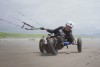
A kite buggy is a light, purpose-built vehicle powered by a traction kite (power kite). It is single-seated and has one steerable front wheel and two
fixed rear wheels. The driver sits in the seat located in the middle of the vehicle and accelerates and slows down by applying steering maneuvers in
coordination with flying maneuvers of the kite.
C kite
( original ) LEI kite with strong C shape. 4 or 5 lines. No bridle.
Canopy
The fabric component of the kite. Usually made from rip-stop nylon and comprised of cells of fabric that form the actual airfoil which is supported
by the bridal system.
CBE Cool Breeze Ejection or KEEGLE - Getting launched from your buggy and landing on your feet. ( PKF inside joke )
Chicken Loop
Sturdy, reinforced loop that is connected to the middle line running through the center of the control bar. It is then "hooked" to the user's harness
transferring the kite's power to the harness.
Chord
The kite measurement between the leading and trailing edges.
Closed Cell
Tapered sock like inlets on a kite that resist air flowing back out. Useful for water relaunch.
Delta C
Delta C kites are a refinement of the hybrid LEI design. Their shape (when flattened out) is more triangular, which places more of the kite's canopy
in the middle. This increases the amount of "projected area" that is exposed to the wind, resulting in more power. These kites still use a bridle
(though it's often extremely simplified), and so could still be called SLE kites. (They are often called C-shaped, but they aren't C-kites as they are
traditionally known.) Delta C-kites are a new breed of hybrid which combines the high-performance of a C-kite with the depowerable fast-turning
triangular Delta kites.
Depower
This system requires a harness to work properly. You must have the kite attached, and have the ability to slide the bar back and forth. A de-powerable
kite changes power by changing the angle of attack. Quick lesson on AoA (you guessed it, Angle of Attack). The AoA affects speed and power of a kite.
The steeper the AoA, the top of the kite if farther away and the bottom of the kite is closer to you. This makes the AoA steep. A shallow AoA puts
both top and bottom of the kite more equal distance from the kite flyer. The steeper the AoA, the slower the kite flies, and it produces more power.
The shallower, the faster the kite is and it makes less power. By adjusting the angle of the kite, you can adjust the power of the kite. When you pull
the bar in, it steepens the AoA, slows down the kite, and makes the power greater. These kites can be reverse launched. They also have an adjustment
strap in which you can change the amount of angle you can get with the bar. These kites are preferred for kitesurfing, landboarding, and snowkiting.
The safety on these kites is built into the de-power system. There is normally a release of some sort on the bar system that when activated, will
collapse the kite get you out of trouble.
Downloop
As the kite is traveling left or right, a 180 degree downward turn causing the kite to travel in the opposite direction.
FB Fixed Bridle - Kites bridle points do not move. Very little AoA adjustment.
Foil
Foil kites are soft kites based on the design of the parafoil. They consist of a number of cells running fore to aft, some or all of which are open at
the front to allow air to inflate the kite so it takes on an aerofoil section. Due to the amount of power that these kites can generate, they can be
used for a variety of different activities including kitesurfing, kiteboarding on land, snowkiting, kite buggying and recreational kiting.
Handles
Used instead of a control bar to fly the kite. In 4 line kites, a pair of bent handles with one power line connected to the top and one brake line
connected to the bottom of each. A "link line" (strop) or harness line can be run between the two handles to allow a harness to take the load of the
kite. Generally considered unsuitable for inflatable kites.
Hindenburg
A reference to the Hindenburg Airship disaster of 1937, which in kiting terminology refers to the kite stalling and then crashing.
HOOJ
awesome..fantastic..wicked
Hooked In
Connecting your kite to your harness. Harness is method of attaching to the kite and spreading the power to your core. Seat and waist harnesses are
most common.
Hot Launch
Launching your kite from the direct down wind direction whether you are standing or sitting in your buggy when the winds are cooking! (not recommended
for beginners)
Hot Wire
A strop on each side of the buggy with a steel ring to hook your QR to. The buggy takes all of the load.
Jibe
To change direction by turning down wind and then continuing to turn until you are going in the other direction. Also spelled as gybe.
Kite Killers
Straps from your wrist to brake lines on FB kites. Safety system for kite handles - allows the kite to deflate and luff to the ground when the
handles are released.
Larks Head Knot
Type of knot used for attaching flying lines.
Leash
A leash or line connecting the kiter to the kite and used to keep the kite from flying away when the control bar is released. A kite leash should
depower the kite when used.
LE Leading Edge - If the kite were flying motionless at the zenith, this is the edge that meets the oncoming wind.
LEI
Leading Edge Inflated - A kite that has an innertube -like bladder along the leading edge of the kite - helps form the kite's shape and provide for
re-launching in water.
Line Bias
Power kites on quad line handles are one of two types. Two line or four line biased. This means how the kite prefers to be flown. A two line biased
kite flies very well on the power (main) lines without any brake (lower/rear) input at all. They are tuned to fly at optimum with only the main lines.
A kite that is quad line biased needs input from the brake lines to get the most out of the kite. Some examples of two line biased kites are (most
beginner kites) Blades, Bullets, Crossfires, Samurais, and beamers. Some four line biased kites are firebees, begos, razors, and just about ALL other
buggy race kites.
Loop
A kite loop is when the kite turns left or right a full 360 degrees.
Luff / Luffing
A condition when there is insufficient wind pressure on the underside surface of the kite to maintain its shape, causing it to lose tension on the
lines and fall out of the sky. Usually associated with flying beyond the edge of the wind window. Also called stall / stalling.
MTB Mountain Board - Beefed up skateboard with pneumatic wheels for skating on sand, dirt, grass, etc. Also called an ATB.
Newbie
A beginner.
Noob
A beginner.
Nuking Winds
Those winds which most of us decide it is time to pack up and play it safe. Requires huge kiwi's and a tremendous amount of experience before this can
be done without taking a ride in a fancy vehicle with flashing lights and sirens!
OBE Out of Buggy Experience or Ejection - Getting launched from your buggy and not landing on your feet.
Open Cell
A foil kite that has no restriction to the air flowing in or out.
Park and Ride
Perfect combination of conditions allowing you to "park" your kite in the wind window and ride for miles without having to work the kite.
PL Peter Lynn - One of the top kite manufacturers.
Pre-inflate
Inflating the cells of a closed-cell foil by opening an inflation vent and allowing the wind or a fan to force air into the kite cells.
Projected Area
The amount of effective kite area once shape has been formed - the amount of area that presents itself to the wind. Arcs have a much smaller projected
area than their measured size. Foils and Lei, less so.
Q Line
A type of flying line of high quality. Does not require sheathing.
QR Quick Release - A mechanical system (usually a Torsion Wichard w/ Holt Allen Block attached) used to release the kite in an
emergency, when hooked in.
Quiver
Collection of kites and related equipment.
Redirect
Reversing the direction of kite travel. If the kite is flying from left to right, then a redirect will change its direction of travel from right to
left.
Reverse Launch
Applying tension on the rear (brake) lines of the kite causing it to rise backwards into the wind window. The kite can then be quickly turned and
flown from this position.
R.I.P. AJ
RTF or R2F Ready To Fly - Means the kite includes the flying lines and control handles or bar.
Safety
A system incorporated into the kite control system to reduce power in a bad situation.
SBSP Sponge Bob Square Pants - known as a mascot in the underground kiting scene and an often used buggy ornament.
Scudding
Sliding on the ground by the pull of the kite - preferably on your feet.
Send It
To move the kite aggressively up through the power zone.
Sheeting In
Pulling the control bar towards you. This typically produces a higher AoA, causing the kite to fly slower, but with more power.
Sheeting Out
Pushing the control bar away from you. This typically produces a lower AoA, causing the kite to fly faster, but with less power.
Sining
Moving the kite in a sine wave pattern (up and down) to generate apparent wind and increase its power.
Skunked
When they forcast wind, but you get there to fly with nothing but a gnat fart.
Span
The width of the kite, the size of the kite measured at right angles to the wind. Usually the longest dimension of a kite.
Spreader Bar
The metal bar that is on the front of a kiters harness. It usually has a hook in the center for holding the harness line or chicken loop.
Stall
A condition when there is insufficient wind pressure on the underside surface of the kite to maintain its shape, causing it to lose tension on the
lines and fall out of the sky. Usually associated with flying beyond the edge of the wind window. Also called luff / luffing.
Strop
Line connecting one handle to the other. Usually connected to your harness to divert some of the kite tension from your arms.
Superman
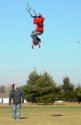
Getting yanked off your feet and pulled forward through the air (flying like Superman). Typically associated with a hot launch.
TE Trailing Edge - If the kite were flying motionless at the zenith, this is the edge that is facing the same direction that the wind is
blowing.
Tip Tuck
Tip tuck can happen when turning and you lose air in the kite. The end of the kite (tip) gets stuck in the bridle and requires some shaking to break
loose.
Trim Strap
A component on the depower line that allows the kiter to increase or decrease the kite’s power by by modifying the length of the depower line.
Usually consists of 2 separate straps – one to increase power and one to decrease power.
Unhooked
Flying your kite without the chicken loop being attached to your harness.
Upturn
Turning the kite up towards the zenith.
Vapor
The fastest buggy race kite at the moment. Manufactured by Peter Lynn.
VPC Variable Power Control – A pulley system on Peter Lynn arcs that allows adjustable performance.
Walk of Shame
The walk back to your to where your kite was originally launched.
Wind Window
The 120- to 180-degree arc of the sky downwind of the rider in which the kite can be flown. Roughly one fourth of a sphere's surface.
Zenith
The point in the sky that is directly over your head - straight up.
2.1m Symphony Beach II Rainbow (Thanks Amazon.com)
3.0m HQ Beamer IV (Thanks K-Bid)
3.3m Pansh Flux (Thanks garydog)
5.6m PL Twister IIR (Thanks Big Mike)
11m HQ Neo II (Thanks kiteplace)
19m PL Venom II (Thanks Smeagol)
MBS Core 95 ATB (Thanks Overstock.com)
Great so far. Still I think "Holes, Airbricks, Rotors, Wind Shadow" and other air turbulance related terms should be included. Unless those things
don't exist anywhere but New Hampshire.
And "Donkey D***"
Ice Screw (primary and back up(s))
Anchor.
Preinflate.
Trim strap.
Nukin'
Skunked
Walk of shame....
I think Bridle is a little off in description. Would it be more accurate to say that it is an assembly of thin lines that comprise the support
structure of a foil canopy?
I think the canopy itself would be considered a seperate component comprised of cells of fabric that form the actual airfoil which is supported by the
bridal system.
And if you're going to mention the Vapor you may as well mention the Synergy as the fastest Snowkite at the moment. (though I think the Charger or
Phantom 2 will change that soon)
That said it's not technically a snowkite or any specific kite. Nor is tha Vapor if someone chooses to use it with a board etc. Unless it is
marketed strictly as a buggy kite I guess.